(Dan Tri) – Australian journalist and photographer Ian Lloyd Neubauer made an eight-day motorbike journey from Hanoi up into the rugged mountain roads of northern Vietnam.
He produced a photo essay setting out his impressions of the beauty of the Dong Van mountains. The essay was published by the British news site BBC.
Setting off
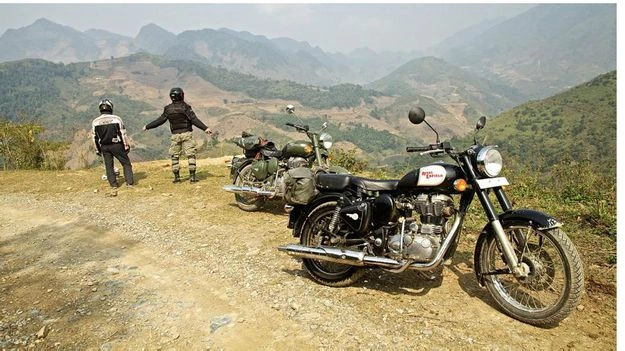
Search Google for “Dong Van” and you will find very little. “If visitors to Vietnam want to see these mountains, they are sent to Sa Pa in the north-west,” says Nguyen Anh Tuan, director of MotoTours Asia, a company specialising in motorbike expeditions across northern Vietnam. “The problem is that in Sa Pa people are used to tourists and no longer take much interest in making friends. But in Dong Van, people still wear their traditional dress, live the way they always have, and are delighted to meet you,” Mr Tuan explains. So I left the endlessly busy traffic of the capital, Hanoi, for an eight-day journey to Dong Van, with a guide, on a vintage 500cc Royal Enfield Bullet — eager to reach a place hardly any foreign visitor to Vietnam has ever seen.
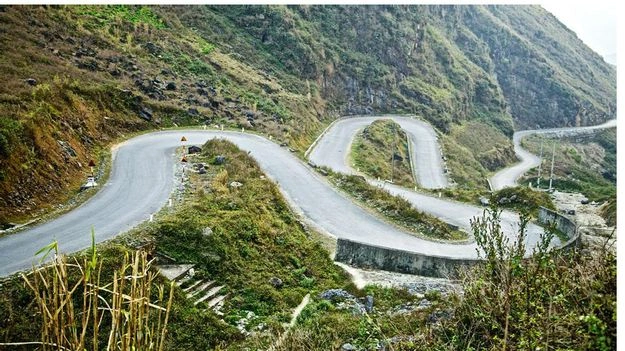
A road that ties your stomach in knots
Dong Van district is largely unknown to foreign visitors, not least because most of the roads and mountain ranges here carry no English signage. Finding your way would be extremely hard without a local guide. But you do not have to be a local, or a rider, to appreciate the sheer feat of engineering that the road up to Dong Van represents. With Do Huu Quyen, our MotoTours Asia guide, we spent a hair-raising day on hairpin bends that snake like a serpent up to a range some 1,500 m high.
As we left Hanoi, Quyen told me that Vietnam’s roads and scenery were the finest of all — better even than Laos, which many regard as the paradise of motorcycle travel . Having now seen roads like these, I have to admit he was right.
Rice terraces
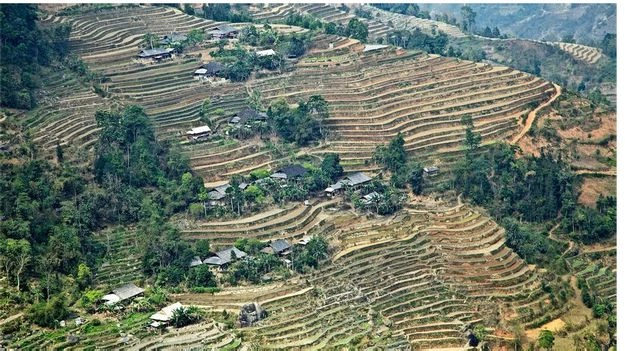
The further north we went, the wider the mountains spread. We rode up to 250 km a day through peaks interspersed with rice terraces — a form of farming so old it is thought to have existed in Vietnam for ten thousand years. February, when we travelled, is the middle of the dry season, and the terraces had turned a deep brown. But in the rainy season, from April to October, they blaze with the green and gold of the growing rice.
Weaving
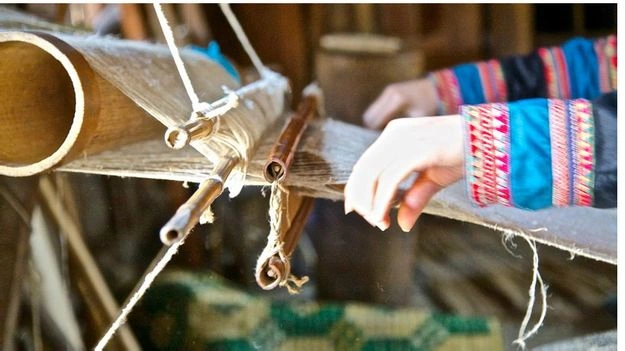
One of the greatest pleasures of exploring north-eastern Vietnam is the chance to meet and talk with the Hmong, an ethnic minority who live in the mountains of South-East Asia. They are easily recognised by their bright clothing: skirts, tunics, shawls and headscarves, meticulously decorated and made by hand from cotton and hemp, then dyed with leaves and roots to produce pinks, reds, purples and indigos.
In a world where so many peoples have switched to T-shirts and convenient ready-made clothes, many young Hmong women still learn to weave and to embroider the traditional patterns handed down from their grandmothers and mothers. I photographed a Hmong woman in traditional dress weaving on the outskirts of Yen Minh, about 90 km from the town of Dong Van, the district capital.
On to Meo Vac
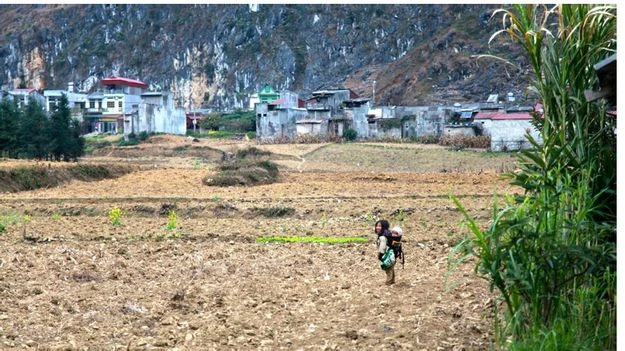
Some 30 km south of Dong Van town lies Meo Vac, a settlement built in Soviet-era concrete and ringed by Hmong villages. Apart from the power lines, the scooters and the mobile phones that are now everywhere, people here still live much as they always have. Every day they drive their oxen out to plough, distil corn liquor, and gather firewood to heat their homes and cook. This photograph, taken by Do Huu Quyen with my borrowed camera, shows a Hmong child carrying her little sister on her back.
The weekend market at Meo Vac
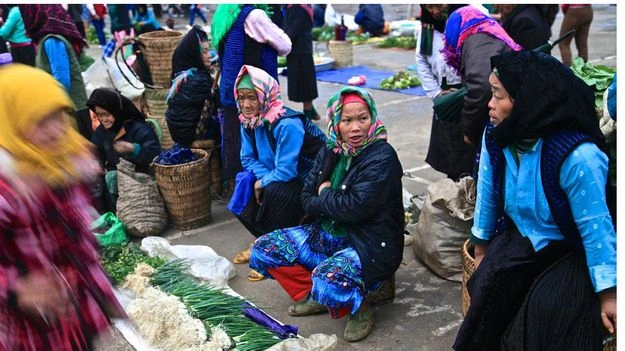
One morning, while it was still pitch dark, we got up at six and headed to Meo Vac’s famous periodic market. Dressed in their Sunday best, thousands of Hmong come here. They buy and sell ginseng, star anise and cinnamon, apples the size of pears and pears the size of melons; pork, goat and dog meat; noodles and tofu. They also sell their home-made corn liquor, a vodka-like spirit that is warm, sweet and fragrant.
Here, for the first time since leaving Hanoi, I saw Western faces: a retired French couple who had come to the market on a local minibus. They were just as surprised to see me — a fair-haired, white-skinned foreigner.
The House of the Hmong King
About 15 km south of Dong Van town, in the Sa Phin valley, stands the House of the Hmong King. It is a two-storey, four-winged residence sheltered by huge limestone crags and set among pine woods. Built in 1902 by Chinese craftsmen for the Hmong lord Vuong Chinh Duc, the building is fortress-like: 500 mm-thick stone walls enclosed by an 800 mm-thick stone rampart, two inner courtyards, 64 bedrooms for the king’s wives and children, quarters for his bodyguards, an opium store, and a large stone slab reserved for beheading traitors.
Only one more Hmong king, Vuong Chi Sinh, who was sympathetic to the communists, lived in this palace before it was abandoned during the war against the French, 1946–1954. Today the House of the Hmong King is a museum with a small collection of home-made objects from the period, displayed in dusty glass cases.
The old town of Dong Van
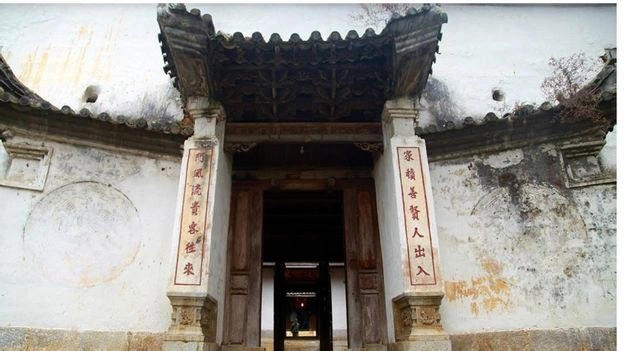
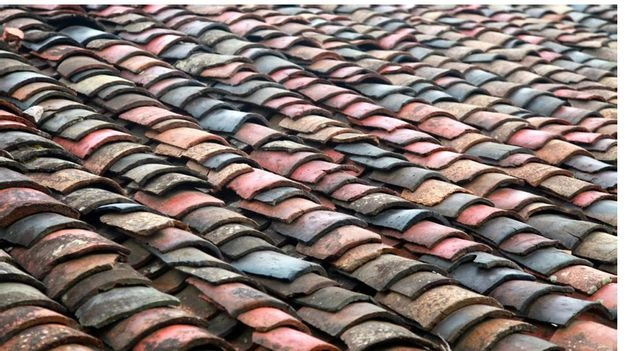
After four days and 900 punishing kilometres on the old but utterly reliable Royal Enfield, we reached Dong Van as night fell. We stayed with a local family in the old town, a maze of gravelled alleys and stone buildings a century old, roofed with fired tiles.
The oldest house here, a large one with two great stone pillars and hanging red lanterns, was built by the Luong family between 1810 and 1820. The Luong descendants still live inside. It is one of the 40 old houses that survived the fire which burned down Dong Van in 1923, before the French rebuilt it.
The end of the road
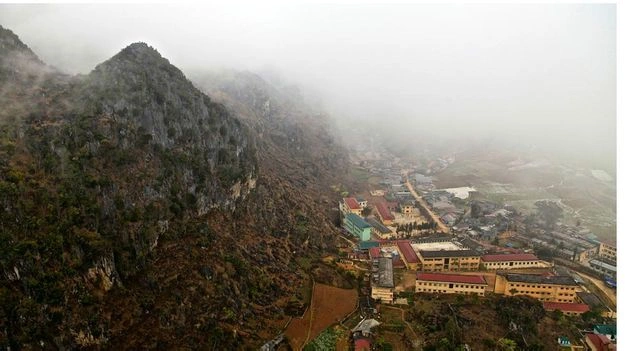
Standing at the strategic heart of the plateau at 1,600 m, and just 3 km from the Chinese border, Dong Van was the furthest northern outpost of the French during the colonial period. French soldiers used Vietnamese labour under Vietnamese foremen to build a large garrison, now lying in ruins atop one of the many limestone cliffs overlooking Dong Van town.
Today you can climb up to this barracks by a steep, rough goat track about 1 km long, leading up from the valley on the eastern edge of the old town. This photograph was taken from the top of the barracks, just as dawn was breaking, while the whole town still lay under the night mist.
Ha Anh
Source: BBC
div class=”mta-related” style=”margin-top:32px;padding-top:20px;border-top:1px solid #E4E7ED”>
Related articles
- RIDING THE TET 2025 ON TWO WHEELS INTO THE WILD LAND
- Ensure your motorbike trip is safe with MotoTours Asia
Suggested tours